
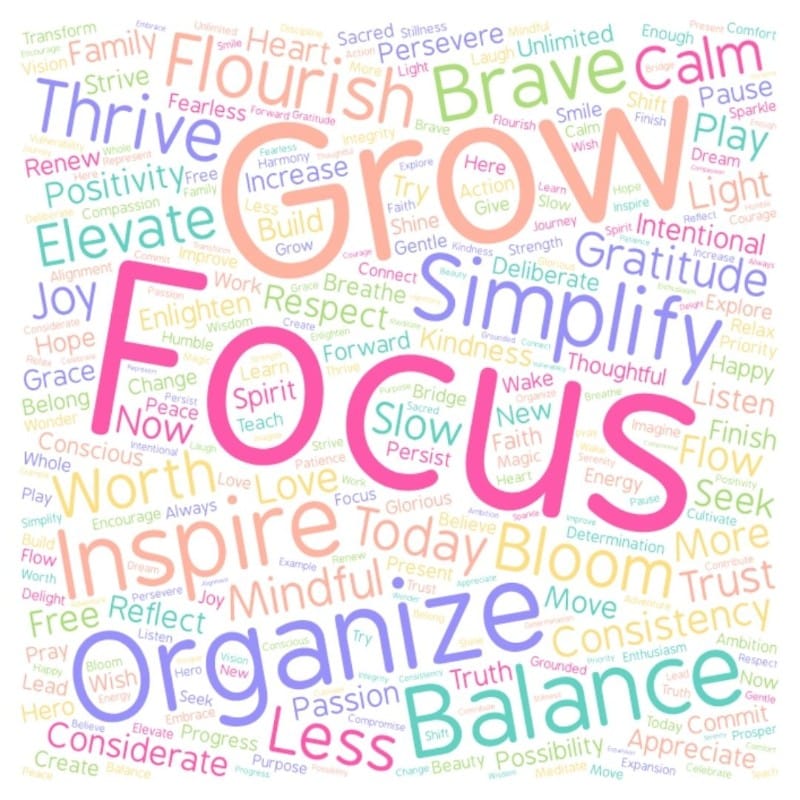
Word of the Year: A Coaching Tool That Works
Perhaps you have come across the concept of Word of the Year, heard it via social media, articles, networking, friends, etc. Maybe it is a practice you engage in, or it might be something new to you.
It is something I have played around with for many years. I personally love the concept, which I will dive into below.
But before I do, let me share my word of the year.
It is vibrant.
Why did I choose this, and what does it mean?
It captures what I want this year to be about for me. Energy. Strength. Life. Engagement.
When I think about being vibrant, it means actively engaging with my own life. Following the things that light me up and saying yes to what matters to me.
Being vibrant means stopping the endless cycle of shoulds and other people’s rules. It means eating well and moving my body because that’s what makes me feel alive, not because someone told me I had to. It means enjoying the beautiful environment I’m in – the ocean, the light, the opportunities. It means connecting with people who lift me up.
Why Word of the Year Actually Works
Unlike goal lists or resolutions, a word doesn’t prescribe specific actions. It gives you something more useful – a lens through which to view your choices.
I use my word, vibrant, as a self-coaching tool throughout my days. I ask myself questions like:
1. Does this choice align with my word?
2. Does doing this give me the feeling I want my word to provide?
3. How can I bring more of my word into this moment?
These questions help me course-correct. When I notice I’m saying yes to something out of obligation rather than genuine interest, ‘Vibrant’ reminds me I have a choice. When I’m deciding whether to skip my workout or take that beach walk, ‘Vibrant’ helps me reconnect with what I actually want.
This is the power of one word. It becomes an anchor point for decision-making without being rigid or prescriptive.
How to Use Your Word
The real value of a word of the year comes from engaging with it, which you can do through:
Daily check-ins: In small moments throughout your day, bring your word to mind. How does it apply to the decision you’re making right now? The conversation you’re having? The task in front of you?
Decision-making filter: When faced with choices – big or small – ask how each option aligns with your word. This is about creating clarity.
Reflection prompts: Use your word to generate questions for journaling or contemplation. If your word is “courage,” you might ask: “Where did I show courage today?” or “Where am I being called to be more courageous?”
Course correction: When you notice yourself drifting or feeling misaligned, your word can help you recalibrate. It can be used for gentle redirection rather than judgment.
The Difference From Goals
Goals are important; they give us direction and momentum. But a word of the year operates differently.
Goals are about achievement, whereas words are about being.
Goals have endpoints, whereas words create ongoing inquiry.
Goals can feel heavy when we don’t meet them, whereas words remain available as tools for reflection, regardless of our progress.
You can fail at a goal, but you can’t fail at engaging with a word.
Finding Your Word
Some people choose their word deliberately, sitting down in January to consider what they need for the year ahead. Others find their word chooses them – emerging from conversation, from observation, from what keeps showing up in their life.
There’s no right way to find your word; what matters is that it resonates, that it feels true, that it offers you something useful as you move through the year.
Your word might be an action: create, explore, release.
It might be a quality: gentle, bold, steady.
It might be a state of being: present, becoming, enough.
The best word is the one that speaks to where you are and where you’re growing.
Beyond January
Here’s what often happens: people choose their word in January with genuine enthusiasm. By March, they’ve forgotten it, and by June, they can’t remember what it was.
But the practice of word of the year isn’t about perfection. If you lose touch with your word, you can come back to it. If you realise your word no longer fits, you can choose a new one. If you never think about it at all, that’s information too – perhaps about what you actually need versus what you thought you needed.
The invitation is simply this: What if one word could help you navigate the complexity of a whole year? What if that word could serve as a touchstone, a question, a gentle reminder of what matters to you?
What word is calling to you?
If this approach resonates with you, you might enjoy exploring our other posts on resolutions, intention-setting, and ways to support your growth. Click here to discover more.